For most governance professionals, the spreadsheet was a stopgap, a just-until-we-get-organized thing, not a deliberate tooling choice. But as it happens in every other business function, that default became a dependency over time.
Today, many of Kuberno’s customers across the globe are organizations working to eliminate spreadsheets for entity management one painful migration at a time. They’re fully aware that spreadsheets were never designed to manage legal entities, and they’re now at a point where the cost of waiting is simply getting too high.
This post is for the General Counsel or Company Secretary weighing up whether the upgrade is worth it — whether from Excel or from a legacy entity management tool that’s not much better. The answer, backed by real-world evidence from Kuberno’s own customers, is unequivocal.
How spreadsheets became the default
Spreadsheets landed on the governance professional’s desk for the same reason they landed everywhere else: they were available, flexible, and free (or close to it). When they were first building their governance processes, the volume of data was manageable. A handful of subsidiaries, a couple of jurisdictions, a few directors to track.
But organizations tend to grow, and what starts as a simple static system of record becomes a sprawling, multi-tab, multi-version document passed between teams with no audit trail, no access control, and no single source of truth.
As we’ve put it in our recent Entity Intelligence whitepaper, entity data is typically “fragmented across spreadsheets, systems, and jurisdictions”. It’s siloed within legal or governance teams, with limited visibility elsewhere.
That multi-tab, hyper-formatted, version-number-infinity monster spreadsheet failed because it was stretched miles past its capacity.
The hidden costs: errors, duplication, and compliance risk
The real danger of spreadsheet-based entity management isn’t what you can see — it’s what you can’t. Here’s what organizations are routinely discovering when they finally audit their entity data:
Duplicate records and conflicting versions.
When Tax, Compliance, and Finance each maintain their own copy of entity data, discrepancies are inevitable. One team’s version shows a director who resigned six months ago. Another lists an entity that was struck off last year. As soon as one of these discrepancies is discovered, it throw the entire document holding it into doubt, and triggers a manual check that makes a small handful of people – and sometimes a single team member! – into an organization-wide data verification bottleneck.
No audit trail.
Spreadsheets don’t record who changed what, when, or why. Or, technically speaking, they do, but not in a way that makes audits practical. For organizations subject to regulatory scrutiny, that’s a compliance liability. Entity records that aren’t audit-ready put the entire business at risk.
Manual compliance calendar management.
When filing deadlines live in a spreadsheet, they depend entirely on someone remembering to check. There’s no automated alerting, no workflow to escalate overdue items, and no way to see at a glance which entities across which jurisdictions are at risk of missed filings. As compliance environments become more demanding — think ECCTA in the UK, or the everchanging BOI reporting requirements in the US — the margin for error shrinks closer to zero.
Entity data locked in legacy systems.
Even organizations that have moved beyond raw spreadsheets often find themselves trapped in legacy platforms that are little more than digital filing cabinets. The data is technically centralized, but it’s static, hard to query, and impossible to visualize.
It doesn’t lend itself to reporting, collaboration, or strategic insight. As explored in Kuberno’s analysis of legal entity data gaps, these systems create a false sense of security while the real problems, such as constant reporting lags or pockets of inaccuracy, persist beneath the surface.
These aren’t theoretical risks. They translate directly into delayed transactions, regulatory penalties, wasted professional fees, and perhaps most damaging of all, eroded trust between governance teams and the wider business.
Why and how Gamma eliminated spreadsheets for entity management
One of the clearest examples of what this shift looks like in practice comes from Gamma, as documented in Kuberno’s Entity Intelligence whitepaper.
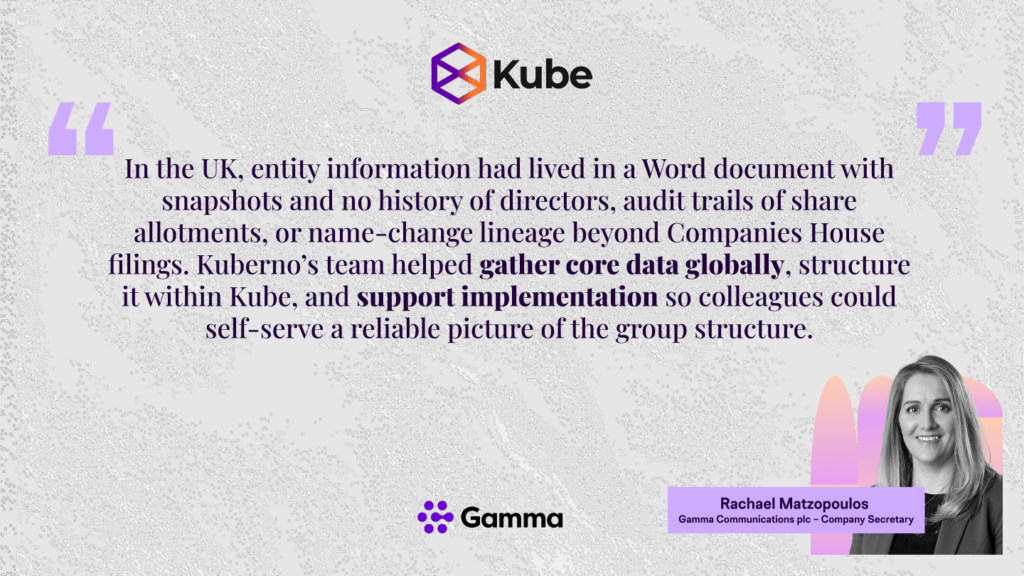
Before adopting Kube, Gamma’s entity information in the UK lived in a Word document, with snapshots of the corporate structure but no history of directors, no audit trail of share allotments, and no name-change lineage beyond what was available through public filings. Across the group, data was scattered across spreadsheets, local systems, and old registers, with multiple versions of the truth creating inefficiencies and low trust in the data.
Kuberno worked with Gamma to gather core entity data globally, structure it within Kube, and support implementation so that colleagues could self-serve a reliable picture of the group structure. For the first time, Legal and Finance teams — previously working in silos — could operate from one clean dataset.
As Rachael Matzopoulos, Corporate Secretary at Gamma, said when she launched Kube internally: “This is our single source of truth.”
The shift was cultural as much as operational. It moved the organization from fragmented, country-by-country records to a shared, holistic view — from chaos to purpose. And it positioned the governance team not as record-keepers, but as the owners of a strategic asset the entire business depends on.
From static records to Entity Intelligence: what the shift looks like
Replacing a spreadsheet with another static tool misses the point. The real opportunity is in moving from entity data management to Entity Intelligence. At Kuberno, we define that as the practice of turning unified, accurate entity data into actionable insight that drives decisions across the enterprise.
Entity Intelligence means your data isn’t just stored; it’s working. It enables you to:
- accelerate deal execution by clarifying ownership and control structures,
- reduce risk through real-time visibility of organizational structure,
- enable agile market entry by surfacing jurisdictional obligations, and
- support ESG and regulatory reporting with verified governance data.
This is the difference between a compliance artefact and a strategic asset. A spreadsheet tells you what was filed. Entity Intelligence tells you where you should look next.
Modern platforms like Kube deliver this through real-time dashboards, interactive org charts, automated compliance workflows, and cross-functional access. This means that governance, tax, finance, and compliance teams all work from the same verified dataset. For organizations evaluating AI-powered options, Kuberno’s buyer’s guide to AI for enterprise entity management offers a practical framework for assessing what good looks like.
How to build the business case for replacing spreadsheets
If you’re a governance professional preparing to make the case internally, the key is to speak the language of the board. Entity Intelligence maps directly to the metrics the C-Suite cares about: growth, efficiency, agility, and resilience to risk.
Quantify the cost of inaction.
How many hours per quarter does your team spend reconciling entity data across spreadsheets? How many times has a transaction been delayed because ownership structures couldn’t be verified quickly? What’s the cost of a missed filing in your most regulated jurisdiction? These are the numbers that make the business case real.
Frame it as a cross-functional investment.
Entity data isn’t just a governance concern. Tax relies on it for structuring. Finance needs it for reporting. Corporate development uses it for due diligence. When entity data is fragmented, every one of these functions builds its own workaround, which duplicates effort and introduces risk. A single source of truth eliminates that waste.
Lead with outcomes, not features.
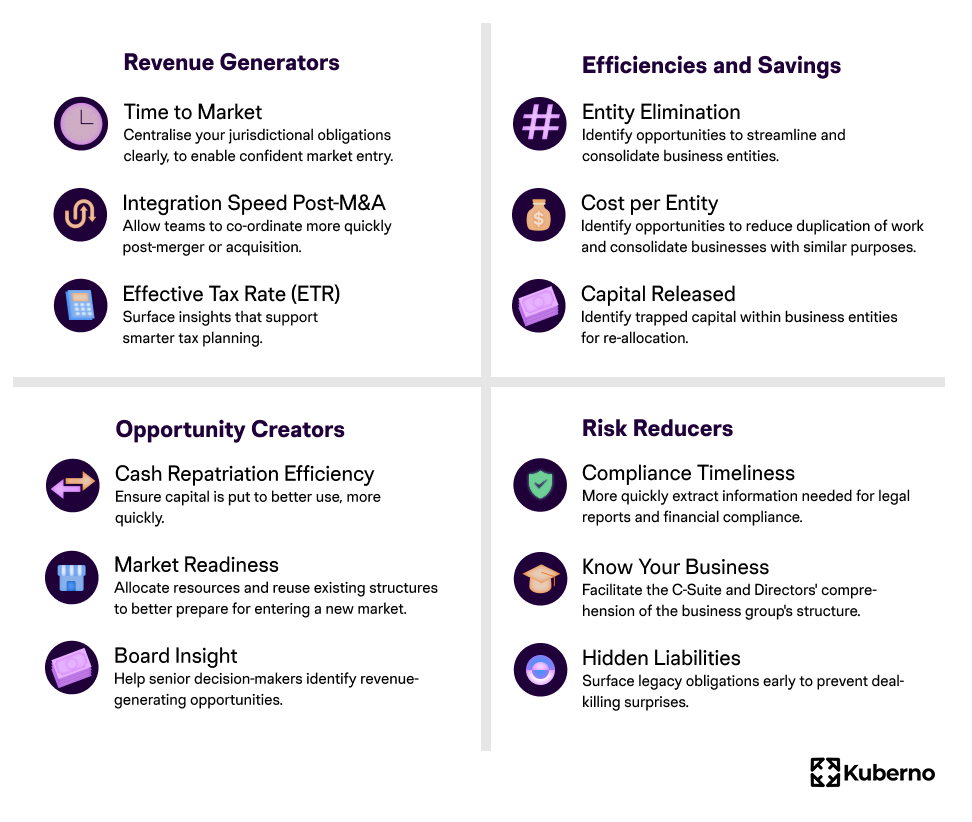
Boards don’t buy software; they buy results. Position the shift in terms of capital released through entity rationalization, faster post-M&A integration, reduced compliance incidents, and improved effective tax rates. The whitepaper’s framework of Revenue Generators, Efficiencies and Savings, Opportunity Creators, and Risk Reducers is a useful lens for structuring this conversation.
Start with an audit.
You don’t need to boil the ocean. Begin by mapping where entity data lives today, who uses it, and where the gaps and duplications are. This baseline alone often reveals enough to justify the investment — and it mirrors the approach Kuberno took with Gamma and other organizations exploring the untapped potential of their legal entity data.
The governance professionals who move first won’t just reduce risk and cut costs — they’ll claim a seat at the strategy table. And that’s a prize worth pursuing.
Ready to see what Entity Intelligence looks like for your organization? Talk to Kuberno.