
The trends in entity management software over the last five years have outpaced the previous decade combined. Connected data architectures, AI, and cross-functional accessibility have moved the category from digital filing cabinet to operational infrastructure.
According to the EY Law General Counsel Study 2025, 75% of legal departments cite developing or refining their legal technology and data strategy as their top digital priority. Entity management sits at the centre of that agenda. Below are five capabilities that are now either next on the roadmap, in beta testing, or already available in leading entity management software.
The Category Has Changed
| Capability | What it means in practice |
| AI-generated compliance calendars | Filing deadlines derived from jurisdiction rules automatically. No manual entry, and the calendar updates when rules change |
| Natural language querying of entity data | Finance, Tax, and Legal ask plain-English questions and get live answers |
| Real-time registry API connections | Entity records update automatically when a filing is made at Companies House or equivalent, including live group structure charts |
| Multi-jurisdictional document generation | Board resolutions, powers of attorney, and statutory filings generated from jurisdiction-aware templates inside the platform |
| Agentic workflow automation | The system monitors entity data continuously and initiates the next step when a trigger condition is met |
-
AI-Generated Compliance Calendars
Until recently, compliance calendars were manual constructions. Someone, usually the person who is most familiar with the jurisdictions, maintained a spreadsheet of deadlines, updated it when rules changed, and hoped nothing slipped through. The process was accurate only as long as that person’s knowledge was current and their own process to keep themselves updated was diligent.
Modern entity management platforms embed jurisdiction rules directly, and that opens the way for AI to prompt users when a change needs attention.
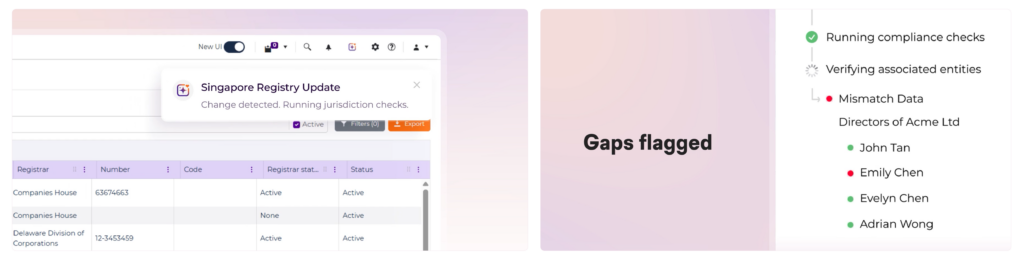
What would that look like? When an entity is added to the system, its statutory obligations populate automatically: annual returns, confirmation statements, filing deadlines, regulatory notifications, derived from the rules of the jurisdiction, no manual entry involved. When those rules change, the calendar updates. Compliance automation transforms what was a knowledge-dependent manual process into a system-generated output that scales with the group.
-
Natural Language Querying of Entity Data
Not long ago, getting an answer from an entity management system meant either knowing how to build the right report or asking the person who did. Finance needed to know what a group’s German entities looked like for a tax filing. Legal needed a list of all entities with a specific director. In both cases, the request went to CoSec, who ran the report and sent it back. While the data was accurate, the dependency on the CoSec made the process tedious and slow.
Leading entity management platforms now support natural language querying. A user can ask the system a plain-English question “which entities in the group have a filing due in the next 30 days?” or “who are the directors of our French subsidiaries?” and receive an immediate, accurate answer drawn from live entity data. No intermediary, no wait time.
The governance operations model this creates id one where Finance, Tax, and Legal Ops interrogate the group structure themselves in real time. It is a significant shift in how entity data is used across the organization.
To see how this works in practice, read our recent product update on smarter document search, which shows how natural language querying extends to document retrieval.
-
Real-Time Registry API Connections
In the previous model, keeping entity records current was a manual task. Someone filed a confirmation statement at Companies House, and someone else, eventually, updated the internal record to reflect it. The gap between what was filed and what the system showed could go from hours to days, or even longer. For groups operating across multiple jurisdictions, this gap was constant.
Modern entity management platforms connect directly to public registries via API. When a filing is made at Companies House or an equivalent registry, the entity record updates automatically. Officer appointments, address changes, and structural amendments flow into the system, bypassing manual intervention. The consequence is that group structure charts reflect the current position at all times, instead of the position as at the last manual update.
-
Multi-Jurisdictional Document Generation
The traditional approach to producing a board resolution, power of attorney, or statutory filing for an entity in a new jurisdiction meant finding the right template, checking it was current, and often involving external counsel to verify it. For groups with entities across ten or twenty countries, document production was a significant overhead.
Modern entity management tools generate these documents from jurisdiction-aware templates held within the system. The platform knows what form a board resolution takes in each country, what language it requires, what execution formalities apply. A user selects the document type and jurisdiction; the system produces a draft populated with live entity data. Hours of reformatting and cross-referencing are reduced to minutes, with consistency enforced across the group.
-
Agentic Workflow Automation
For most of its history, entity management tools were passive. They held data well, and could be queried, but they initiated nothing. A human had to notice that a deadline was approaching, decide what action to take, and manually trigger it. The system stored the outcome. It did not drive the process.
Modern platforms with agentic capabilities have inverted this model. The software monitors entity data and compliance status continuously. When a trigger condition is met, a deadline approaching, a filing confirmed, or a director appointment recorded, it initiates the next step automatically: generating a task, preparing a document, escalating an alert, or progressing a workflow.
As agentic AI becomes embedded in entity management, the shift from data storage to workflow orchestration is becoming a baseline expectation rather than a differentiator. The system acts. The governance team oversees. For a deeper look at where this trajectory leads, read our latest thinking on the future of entity management AI software.
The AI Gap in Entity Management
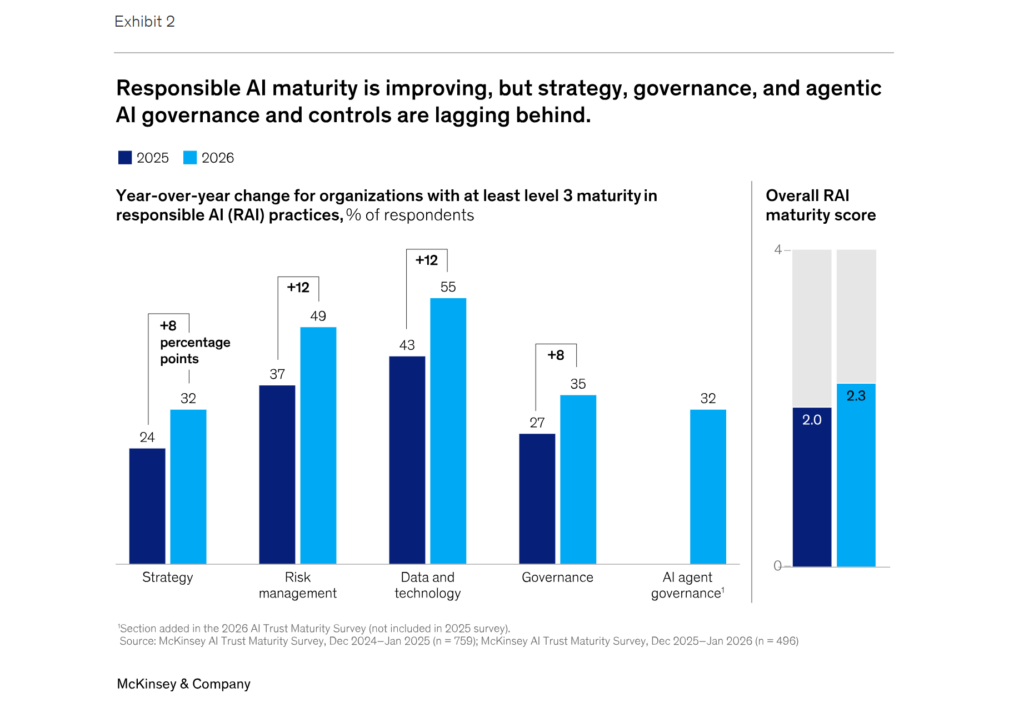
The technical capabilities behind these features are available now in leading entity management platforms, and they are redefining what the function can deliver. But the gap between what is technically possible and what most governance teams are actually using is, in many organizations, still significant, as McKinsey’s AI Trust Maturity 2026 survey reveals. That gap is not only about AI, but it is particularly visible there.
For many buyers, AI remains difficult to evaluate. The compliance implications of getting it wrong are personal for compliance and legal professionals, not theoretical. That creates a rational hesitation, and most entity management providers have responded accordingly: shipping surface-level AI features that look modern but avoid the harder questions around accountability, audit trails, and decision transparency.
The result is a market where the safest features get prioritized over the most useful ones. The AI capabilities that could genuinely transform how governance teams operate are precisely the ones that require deeper collaboration between vendor and customer to implement responsibly.
What This Means for Governance Teams in 2026
The teams closing the gap are not the ones waiting for AI to feel safe. They are working with platforms willing to do the harder work: not just shipping features, but actively collaborating on solutions that fit the accountability structures needed in governance roles.
Those are the teams whose governance function is becoming a competitive asset rather than an administrative overhead.