

Tech-savvy legal teams treat entity data as governance infrastructure rather than administrative record-keeping. They recognize that strong legal entity governance underpins everything from board reporting to transaction readiness.
The best practices below reflect what leading teams implement to build clarity, control and confidence across their portfolios, translating entity management best practices into operational discipline.
1. Establish a single source of truth with modern legal entity management systems
Most governance issues begin with fragmentation. The legal team produces an ownership diagram, which is later updated separately in a finance presentation. Director details are passed from legal to tax in spreadsheets because their systems are not properly integrated. A company secretarial colleague exports filings into shared folders because the entity management platform is not consistently used across the organisation, leading to version lags and blurred accountability, where accuracy depends on manual alignment.
Real-time, structured entity data is foundational to modern governance because oversight is impossible without visibility. Establishing a single source of truth therefore requires more than central storage. Purpose-built systems centralize every relevant type of entity data points in relational databases:
- ownership records with all the relevant beneficiary details
- officer information, including the entities to which they are linked
- filings and governance documents, from board minutes to formation or structure documentation
All of the above sit within one structured environment, which not only shrinks the margin for human error, but also makes it possible to build complex automation and end-to-end governance workflows.
When ownership hierarchies are maintained as live relational records rather than static charts, changes flow automatically through the structure, improving reporting accuracy, strengthening audit readiness and supporting faster mergers and acquisitions (M&A) preparation without the need to reconstruct history under pressure.
Action
Map where your entity management data currently lives. If more than one system is required to produce a full ownership view, prioritize consolidating into a structured, purpose-built platform.
2. Automate compliance tracking as a core entity management best practice
Regulatory obligations operate continuously, which makes manual tracking inherently reactive and risky. Integrated compliance calendars, dashboards and automated document workflows, on the other hand, shift compliance from memory-based monitoring to structured accountability. No one individual owns the single source of truth on any governance data when it sits in a system with pre-determined roles and permissions.
High-performing governance teams rely on this embedded accountability to prevent gaps, duplication and governance drift. Even when portfolios expand, manual friction stays minimal, and operators keep control and oversight of their entity data.
Action
Review how compliance is currently tracked. If deadlines are monitored manually, if the same data point has to be updated in multiple locations, if every new entity adds a disproportionate amount of work on the team’s plate, implement automated calendars, dashboard visibility, and core bulk management features for your legal entities.
3. Embed strong data governance to meet transparency and beneficial ownership requirements
Entity data includes sensitive personal information about directors and shareholders, making compliance with the Data Protection Act 2018 and UK GDPR inseparable from modern entity management.
At the same time, expanding transparency regimes have elevated data governance from a cybersecurity consideration to a core regulatory obligation. In the UK, the Economic Crime and Corporate Transparency Act 2023 strengthens identity verification and enhances Companies House enforcement powers, while in the United States the Corporate Transparency Act requires beneficial ownership reporting to the Financial Crimes Enforcement Network. Taken together, these developments signal a clear expectation that ownership data must be accurate, structured and readily accessible.
Role-based access, encryption, audit trails and embedded ownership tracking ensure records are accurate, controlled and compliance-ready, enabling organizations to generate beneficial ownership reports directly from structured system data.
Action
Review access controls and audit trails within your legal entity management system, and test whether you can produce an accurate beneficial ownership report within 24 hours using structured system data.
4. Standardize and formalize your corporate entity management framework
Even the most sophisticated system cannot compensate for inconsistent processes. Leading governance teams invest in documented frameworks that bring clarity and consistency to their entity management.
- Define authority and accountability. A subsidiary governance framework should set out authority levels, escalation paths and minimum standards for key actions while clarifying responsibilities between legal, tax and finance.
- Design for change, not just compliance. Your framework and systems need to accommodate structural complexity as a default, not as an exception. When processes are configurable enough to allow for this complexity, quality becomes repeatable rather than dependent on pockets of knowledge or experience across the organization.
- Treat process discipline as a maturity marker. Governance maturity is as much about process discipline as data accuracy. The organizations that get this right don’t just have good data — they have consistent, auditable ways of working that hold up across teams and jurisdictions.
Action
Document your core entity management workflows and confirm they are applied consistently and appropriately in their relevant jurisdictions.
5. Conduct regular entity health checks as part of entity management best practices
As structures evolve through acquisitions and restructurings, dormant or redundant entities tend to accumulate. Each one carries compliance obligations, audit costs and administrative burden while adding no commercial value. Regular portfolio reviews help reduce this drag by confirming compliance status, assessing commercial purpose and identifying candidates for elimination before they become obstacles during transactions or expansion.
Action
Schedule a structured portfolio review and require a documented commercial rationale for each retained entity.
6.Strengthen board reporting through centralized legal entity management oversight
Entity management should support executive decision-making rather than operate as a background administrative function. When governance data is fragmented across subsidiaries and jurisdictions, board discussions rely on partial information, introducing uncertainty into strategic decisions and limiting central visibility.
In a regulatory environment shaped by legislation such as the UK Bribery Act 2010, where group-level oversight and adequate procedures are critical, incomplete visibility across subsidiaries presents more than administrative inconvenience.
In multinational groups, local entities often manage filings independently, which can create inconsistent standards and obscure risk exposure at group level. By aligning processes and consolidating governance reporting within a structured system, organizations reduce duplication, improve cost transparency and ensure that risk exposure is visible and controlled across the portfolio.
Real-time dashboards and structured reporting templates translate entity data into usable governance intelligence, linking legal entity management directly to capital planning, restructuring and transaction strategy. When boards trust that governance data reflects real-time status across jurisdictions, oversight is grounded in accurate information rather than assumption. As frequently emphasized in guidance from the Institute of Directors and National Association of Corporate Directors, directors must be able to rely on accurate information to discharge their duties effectively.
Action
Review the entity data currently presented to your board, map governance responsibilities across jurisdictions, and identify opportunities to centralize oversight within a single structured reporting framework.
7. Use AI and integrated systems to scale entity management sustainably
Entity management systems must accommodate expansion into new jurisdictions, M&A activity and restructuring without destabilising governance. As portfolios grow, scalability depends not only on structured infrastructure but also on intelligent automation. Technology should multiply governance capacity.
Interrogating documents with natural language
Governance teams frequently need to locate references to specific past board resolutions or approval thresholds buried across large document sets. AI-powered natural language querying allows users to search these materials directly, surfacing relevant clauses or decisions in seconds rather than hours of manual review.
Answering data-based questions at speed
Recurring questions about entity status, filing deadlines or ownership structures often require staff to cross-reference multiple documents or systems. AI can handle these high-frequency queries by drawing on integrated data sources, reducing the burden on legal and compliance teams and enabling faster, more consistent responses.
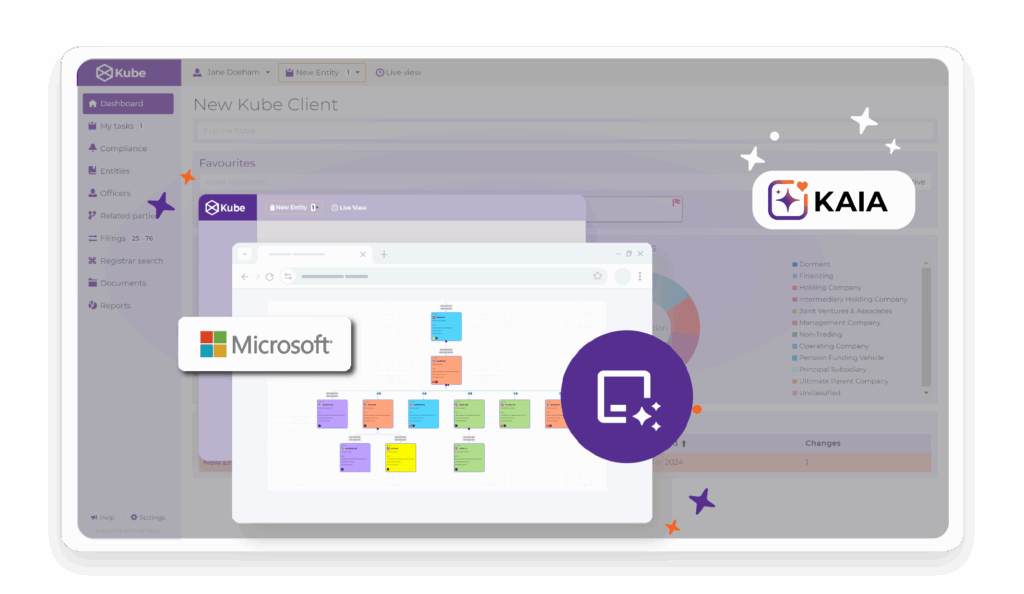
Tools such as KAIA, Kuberno’s AI assistant, further support governance teams with drafting, jurisdictional navigation and information retrieval under human oversight. In this way, scalable technology becomes central to sustainable entity management best practices, ensuring governance evolves alongside commercial expansion.
Automating document tagging and regulatory monitoring
AI can support automated data extraction, document tagging and regulatory monitoring within integrated workflows, reducing manual error and enabling teams to manage increasing entity volumes without proportional increases in administrative workload. Broader research on automation in knowledge work, including analysis published by McKinsey & Company, indicates that structured workflows and intelligent systems allow organizations to scale output without proportional increases in staffing.
When legal entity management platforms connect with tax systems, HR platforms, ERP and contract management tools, legal structures remain aligned with operational systems as the organization expands, avoiding reactive remediation during periods of rapid growth.
Action
Identify one repetitive governance task to automate or pilot with AI, and assess whether your current legal entity management framework could support significant portfolio growth without additional headcount.
8. Reduce operational friction between legal, tax and finance
Entity management sits at the intersection of legal, tax and finance, and when each function maintains its own records, discrepancies multiply and nobody knows which version is correct. When finance and tax can self-serve their entity data needs through role-based access to a single authoritative system, shadow systems disappear and governance infrastructure is used rather than worked around. Cross-functional adoption is a legal strategy.
Action
Create a process that enables legal, tax and finance teams to self-serve their entity data within a shared, connected system designed for organization-wide use.
Implementing entity management best practices: where to start
Start with a visible problem that causes real pain, even if it’s not the most fundamental one. This can be missed compliance deadlines, hours spent preparing board reports, or one business function that needs better access to a specific subset of data. Solving this first problem creates momentum and trust that paves the way for tackling more complex underlying issues.
The long-term solution may involve redesigning processes end-to-end, or implementing new technology at a foundational level, which takes time and coordination. Early, tangible improvements can therefore play an important role in building internal confidence and securing buy-in for the deeper structural changes required to create lasting resilience.
Excellence in legal entity governance requires treating it as infrastructure rather than a necessary burden. Kuberno’s platform provides the infrastructure. The organizations succeeding with entity management are invested in proper tools, define clear processes, assign real accountability, and make governance a priority. The results justify the effort.