
The corporate secretary, or company secretary, as the role is known in the UK, has existed in recognisable form since the early days of the joint-stock company. The work has always involved the same core obligations: maintaining statutory registers, recording decisions, ensuring filings are made, keeping the corporate record current and intact. What has changed substantially over the last two decades, is the infrastructure available to do the job in a modern context.
This post traces how the corporate secretary function evolved alongside that infrastructure, and what that evolution means for where the function is heading next.
1. Before Software: A Clerical and Document-Driven Function
For most of the twentieth century, corporate secretarial work was primarily a records management discipline. Statutory registers were physical books. Minute books were maintained by hand or typewriter. Filing deadlines were tracked manually, and constitutional documents lived in physical files or deed boxes. The function’s tools were paper, filing cabinets, and institutional memory. As our History of Governance series sets out, governance structures in this era were largely bureaucratic by design: hierarchical, process-bound, and built on documented authority rather than connected data.
In listed companies, the company secretary or corporate secretary was typically a senior, professionally qualified role, often a chartered secretary in the UK, or a legally trained officer in the US. In smaller organisations, the function was absorbed into general legal or administrative duties, carried by whoever held the relevant knowledge rather than whoever held a connected title.
The underlying challenge was already present: the work required accuracy across a body of information that changed continuously, with no infrastructure to enforce consistency or flag gaps.
2. The First Wave: Digitisation Without Integration
From the late 1990s through the 2010s, the corporate secretarial function moved from paper to screen. Spreadsheets replaced ledgers, and with that, early databases began to hold entity information in structured form for the first time.
However, while the toolbox changed — and brought with it the advantages of moving away from paper formats — the underlying model stayed the same: siloed data with no connecting thread, and heavy reliance on institutional knowledge to fill in the gaps.
At the same time, the scope of the function was expanding. Sarbanes-Oxley in 2002 raised the stakes for corporate record-keeping in the US. Beneficial ownership disclosure requirements grew across multiple jurisdictions. Corporate groups became more international, adding entities that each carried their own filing obligations. The second phase of governance’s evolution brought greater regulatory complexity to a function whose tools had not kept pace with the demands being placed on them.
This pressure accelerated a structural shift that was already underway: the corporate secretary function began migrating into adjacent roles. General Counsel teams absorbed it. Legal Operations took it on. In some organisations, Finance carried entity records because they sat closest to the data. The trend of General Counsels taking on the company secretary role reflected a genuine consolidation of governance operations under legal leadership.
3. Who Carries the Function Today
The corporate secretary function is not, in most organisations, a standalone full-time role. Where it sits depends on size, structure, and geography.
In large listed companies, a dedicated corporate secretariat team manages entity records, board governance, and statutory compliance as a defined function. In mid-market organisations, the General Counsel’s team absorbs it alongside broader legal responsibilities. In smaller corporate groups, it falls to whoever has the closest relationship with the data; sometimes that is Legal, and sometimes it’s a single individual carrying the institutional knowledge for the whole group.
The terminology also diverges by jurisdiction. In the UK, “company secretary” is a defined professional designation with its own qualification pathway through CGIUKI, and the role has historically been a board-level appointment for listed companies — which is partly why company secretary software has historically been designed around UK statutory requirements. In the US, “corporate secretary” is more commonly a title held by the General Counsel or a senior legal officer, and corporate secretary software has had to evolve to reflect that broader, less defined scope. The emergence of governance operations as a discipline reflects an effort to give this distributed, often unnamed function a more coherent professional identity, regardless of where in the organisation it sits.
What has not changed, wherever the function sits, is the underlying work: entity records need to be accurate, filings need to be made following their respective deadlines, group structure needs to be up to date, and the whole body of information needs to be retrievable when it matters.
4. What Corporate Entity Management Software Changed
The shift from spreadsheets and shared drives to purpose-built corporate entity management software changed the nature of the work in a way that earlier digitisation had not. The fundamental difference lies in the structure. A register entry in a spreadsheet is a cell. A director record in a corporate entity management system is a node: connected to every entity in which that individual holds an appointment, to every document that references them, to every obligation their presence triggers.
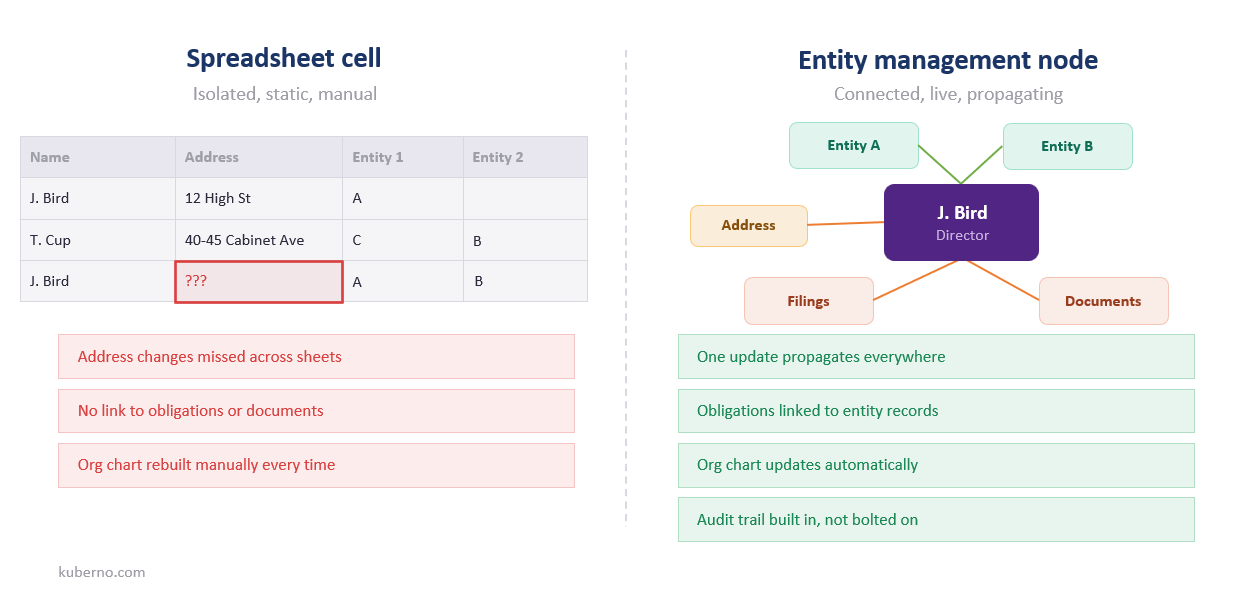
This has practical consequences. When an officer changes address, one update propagates everywhere. Similarly, when the group decides to dissolve an entity, the software automatically clears its obligations from the compliance calendar, and reflects it in the group structure chart. That is why the quality of the governance function depends on how that underlying data is architected: because those neural connections cannot be made using spreadsheets. And subsidiary and management applications are the first class of tools built explicitly around that principle.
The other change is accessibility. In a paper or spreadsheet-based model, the corporate secretary or CoSec team was the gatekeeper of entity information. Requests came in and information went out manually. In a connected system, the function moves from gatekeeper to steward: the responsibility for data quality remains, but the bottleneck is removed, as governance teams configure access to allow Tax, Finance, HR or Operations teams to self-serve as teh need arises.
5. Where the Function Is Heading
The trajectory is toward a function that is more strategic and less administrative. Agentic AI is beginning to take on the routine operational layer: generating compliance deadlines from jurisdiction rules, preparing filing workflows, flagging structural changes that require action, and so on. The work that remains for the human function is oversight, judgement, and governance design.
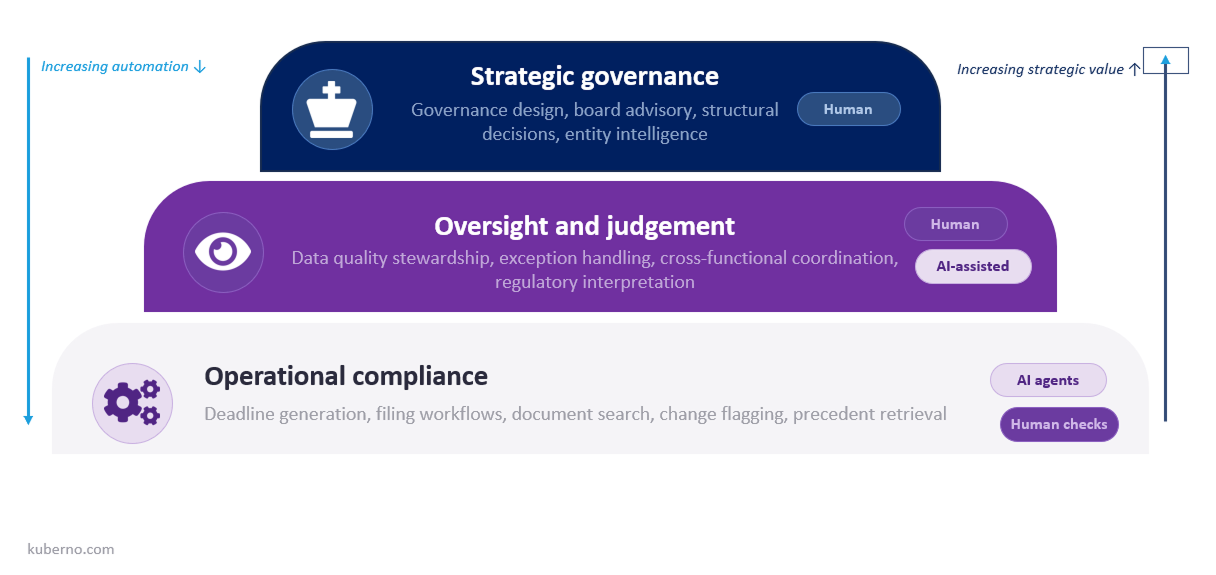
This is the direction our History of Governance Part 3 blog article points toward: governance structures shifting from bureaucratic and hierarchical to data-driven and accountable. For corporate secretarial teams, that means the value of the function increasingly lies in what they do with accurate, accessible entity data, rather than in maintaining it manually.
Two Decades of Change, With More to Come
Corporate entity management software gave the corporate secretary function the infrastructure it had long needed: fit for the scale and complexity of modern corporate groups.
For governance teams carrying this function today, whether as a dedicated CoSec team, a General Counsel’s department, or a legal ops function, the question is less about whether to adopt purpose-built software and more about how to use it well. The tools now exist to make corporate entity management always accurate, with easily accessible data, and truly cross-functional. The organisations that take that seriously are the ones whose governance infrastructure will hold when it is tested.